The Mystery of Jesus
After John gets arrested, Jesus returns to Galilee and starts proclaiming God’s Good News. “The time has come, and the Kingdom of God is almost here! Repent and believe in the Gospel!”
As Jesus walks beside the Sea of Galilee, he sees two brothers named Simon and Andrew fishing. He calls to them, “Follow me, and I will make you fish for people!” They immediately drop their nets and follow him. A bit farther, he sees two more brothers named James and John mending their fishing nets, and he calls them as well. They instantly leave their father Zebedee and his workers in the boat and follow Jesus.
Jesus and his four disciples travel to the town of Capernaum on the northwestern shore of the Sea of Galilee. He enters a synagogue and starts preaching on a Saturday, the weekly Jewish day of rest called the sabbath. The people marvel at his teaching because he speaks with authority and not like the scribes who merely interpret the Hebrew scriptures.
Suddenly a possessed man cries out, “What do you want with us, Jesus of Nazareth? To destroy us? I know who you are … the Holy One of God!”
“Shut up and get out of him!” Jesus rebukes the demon. It shakes the man’s body and leaves with a loud cry.
Shocked by what they have just witnessed, the people in the synagogue ask each other, “What’s this? A new teaching with authority? Even demons obey his commands!” And Jesus quickly becomes famous throughout the region.
After leaving the synagogue, Jesus and his four disciples go to Simon and Andrew’s house, where Simon’s mother-in-law is in bed with a fever. Jesus takes her hand and lifts her from the bed. Her fever breaks at once, and she serves them food and drinks.
That evening, after the sabbath has ended, all the townspeople crowd around the door of the house, bringing to Jesus everyone who is sick or possessed. He cures many diseases and casts out many demons, silencing them so they cannot reveal his true identity.
Early the next morning, while it is still dark, Jesus awakes and goes out to a deserted area to pray. When Simon and the others awake, they search for Jesus and find him praying. “Everyone’s looking for you,” they say.
“Come on,” Jesus responds, “Let’s move on to some other towns so I can preach there as well. After all, that’s why I’m here!” So he travels throughout Galilee, preaching in synagogues and casting out demons.
One day a man with leprosy kneels before Jesus and begs him, “If you want, you can make me clean!”
Moved with compassion, Jesus stretches out his hand and touches the man. “I do want it. Be clean.” The leprosy immediately leaves him, and he is clean. Jesus sends the man away at once, warning him sternly, “Make sure you don’t tell anyone about this. But go show yourself to the Temple priest and offer what the prophet Moses commanded for purification after healing from leprosy (Leviticus 14:1-9). That should be enough proof for everyone.”
But the man goes off and spreads the word far and wide about what Jesus has done, and Jesus becomes so famous that it is now impossible for him to enter a town. So he stays in the countryside, and people travel from all over the region to see him.
After several days, Jesus returns to Simon and Andrew’s house in Capernaum. When news gets around that Jesus is there, so many people show up to hear him teach that even the front door has no room left.
Four men carry their paralyzed friend to the house. Realizing that the crowd is in their way, they make a hole in the roof and lower their friend into the house on a mat. When Jesus sees their faith, he says to the man, “Son, your sins are forgiven.”
Now some of the scribes are sitting there, asking themselves, “How can this guy talk like this? He’s committing blasphemy! Who can forgive sins but God alone?”
Jesus suddenly senses what they are thinking and questions them, “Why are you thinking these things? Which is easier? To tell a paralyzed man that his sins are forgiven? Or to tell him to pick up his mat and walk?” Then he looks back at the paralyzed man and commands him, “Hey, you. Get up. Pick up your mat and go home.” The man stands up at once, picks up his mat, and leaves the house right in front of everyone’s eyes! Absolutely astonished, the crowd glorifies God, “We’ve never seen anything like this!”
So now you know, dear reader, that the Son of Man has authority even to forgive sins.
Later Jesus goes out again near the sea, and the whole crowd gathers there to hear his teaching. One day, as walks along the seashore, he spots a man named Levi, son of Alpheus, sitting at a tax booth. “Follow me,” Jesus says, and Levi gets up and follows him.
That evening, Jesus and his disciples have dinner at Levi’s house along with a bunch of infamous sinners, as well as tax collectors, who are commonly regarded as extortionists. By now, all kinds of people are following Jesus, but the scribes and the Pharisees (leaders of a popular Jewish reform movement) notice that he is dining with sinners and tax collectors. So they challenge his disciples on this point, “Why does he eat with sinners and tax collectors?”
When Jesus hears this question, he answers, “Doctors are for the sick, not for the well. So I’m here to call the sinners, not the saints.”
The scribes and Pharisees also challenge him about fasting, “Why don’t your disciples abstain from eating food like the followers of John the Baptist or the Pharisees?”
Jesus responds, “Can wedding guests fast while the groom is with them? Of course not. The day will come when the groom will be taken away. Then they will fast. Think about it. Nobody sews a new patch on an old coat. Otherwise the new patch would shrink and pull away from the old coat and cause an even worse tear. And nobody puts new wine into old wineskins. Otherwise the skins would burst open as the wine ferments and expands, and everything would be ruined. Likewise, it wouldn’t make sense to follow old rules about fasting in this new time of joyful fulfillment.”
The next Saturday, while Jesus is walking through a wheat field, his disciples start plucking and eating some grains. The Pharisees again challenge him, “Look! Why are your disciples doing unlawful work on the sabbath?”
Jesus answers, “Haven’t you read what King David and his companions did when they were hungry and needed food? They went into God’s house and ate the holy bread that only priests were allowed to eat,” (1 Samuel 21:1-6). Then Jesus tells them, “God didn’t make people to benefit the day of rest. He made the day of rest to benefit people.”
So now you know, dear reader, that the Son of Man is Lord even of the sabbath.
Later the same day, Jesus goes to a synagogue, where he sees a man with a disabled hand. The Pharisees watch to see if Jesus will heal the man so they can accuse him of breaking the sabbath. Jesus calls to the man, “Come here.” Then he challenges the Pharisees, “What do you think? Is it lawful to do good or evil on the day of rest? To save a life or destroy it?”
The Pharisees remain silent. Jesus looks around with anger and grief at their hardened hearts. Then he looks at the man, “Stretch out your hand.” The man extends his hand and discovers that it is restored to full mobility! Seeing enough, the Pharisees leave and conspire to destroy Jesus with supporters of Herod Antipas, the Galilean Jewish ruler.
Jesus and his disciples leave again for the sea, followed by huge crowds from the regions of Galilee and Judea, including from Jerusalem. Masses of people also travel to see him from the regions of Idumea, in the far south; Perea, east of the Jordan River; and Phoenicia, in the far north (see map).
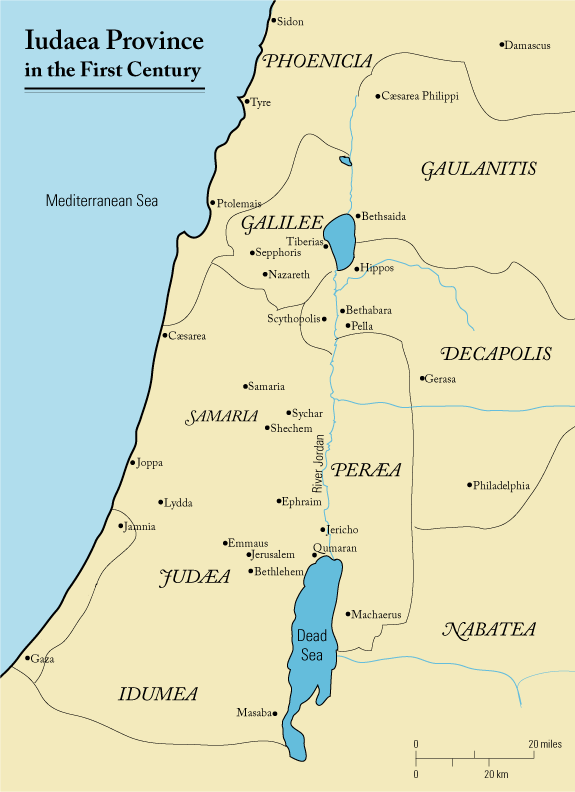
He tells his disciples to get a boat ready so he can preach without being crushed by the crowd. By now, he has cured so many people that everyone with a disease pushes forward just to touch him.
Whenever demons see Jesus, they fall down before him and shout, “You are the Son of God!” But he sternly warns them not to reveal his identity.
One day, Jesus hikes up a small mountain and summons 12 men, symbolizing the 12 tribes of Israel, to join him. The men climb up to him, and he ordains them as his 12 apostles, meaning those “sent out” on a mission. The men must stay close to him and learn his message so they can later go forth with his authority to preach the Good News and cast out demons. These are the names of the 12 apostles:
- (1) Simon, whom Jesus renames Peter, meaning “Rock,”
- (2&3) James and his brother John, sons of Zebedee whom Jesus calls “Sons of Thunder,”
- (4, 5, 6, 7, 8) Andrew, Philip, Bartholomew, Matthew, Thomas,
- (9, 10, 11) James the son of Alpheus, (Jude) Theddeus, Simon the zealot, and
- (12) Judas Iscariot, who will eventually betray Jesus.
After ordaining the apostles, Jesus returns to his home in Nazareth. Such a huge crowd gathers there to see him that he and the apostles cannot even eat. His family, hearing about the commotion and thinking that he has lost his mind, sets out to seize Jesus.
While his family members are on their way, some scribes who have come up from Jerusalem accuse Jesus, “He’s possessed by Baal-zebub, the prince of demons! That’s why he can drive out other demons!”
Jesus calls them over and speaks to them in parables, “Tell me something. How can Satan drive out Satan? A kingdom or a house cannot stand if it’s divided against itself. So Satan also cannot stand if he revolts against himself. He’s kaput! But if you want to break into a strong man’s house and steal all his stuff, then you’ll have to tie him up first! Right?” Jesus continues, “Now, you guys said that I’m possessed by a demon. So let me tell you something frankly. God will forgive people for all kinds of sins and blasphemies. But whoever rejects the Holy Spirit can never be forgiven because that person is guilty of an eternal sin.”
Suddenly Jesus’s mother and other relatives show up to take him home. Standing outside, they send a messenger through the crowd to say, “Jesus, your family’s outside calling for you.”
“Who is my family?” Jesus replies. He gazes at the people seated around him and smiles, “Oh! Here they are! Whoever does the will of God is my family.”
Some days later, Jesus goes out again to teach by the sea. Such a huge crowd gathers around him on the shore that he gets into a boat and speaks from the sea. Using parables, he teaches the people many things.
“A farmer went to scatter seeds on the ground. Some of his seeds fell on a road, and the birds swooped down and gobbled them up. Other seeds fell on rocky ground and sprouted quickly. But there wasn’t enough soil, so they couldn’t grow any roots and got scorched in the sun and withered away. Others fell among thorny weeds, which grew up around the plants and choked them so they couldn’t yield any grain. Finally, some seeds fell on rich soil and produced good fruit—and not just a little, but 30 or 60 or 100 times the normal amount!” Jesus pauses for a moment, then adds, “If you have ears to hear, then you’d better listen.”
Later, when Jesus is alone with his closest disciples, including the 12 apostles, they ask him about this parable. “You all are privileged to know the mysteries of God’s Kingdom. But those folks out there must hear everything in parables,” he tells them. “Like it says in Isaiah 6:9-10, ‘They may look but not perceive, listen but not understand, so they may not turn and be forgiven.’”
Then Jesus asks them, “Don’t you understand this parable? If not, then how will you understand any of them?” Finally, he explains, “Look, the farmer’s seeds are like the Word of God, our message, the Good News. Now, some folks are like the road. As soon as they hear God’s Word, Satan swoops down like the birds and snatches it away from them. Others like the plants in rocky ground. They joyfully receive the message, but they don’t have any roots. So they only last a little while. As soon as they face trouble or persecution, they fall away. Still others are like those among the thorny weeds. They hear the Good News, but worldly worries and desires for wealth and other things rise up and choke out God’s Word. So they bear no fruit. Finally, some people are like the plants in rich soil. They hear the message, accept it, and bear good fruit—30 or 60 or 100 times the normal amount!”
Here are a few more of Jesus’s parables:
“Would you bring a lamp inside and put it under a basket or under your bed instead of on the lamp stand? Of course not. Well, nothing gets hidden except to be revealed. Nothing is kept secret except to come to light. If you have ears to hear, then you’d better listen!”
“Ok, listen to this! The measure that you give will be the measure that you get … and then some! For the haves will get more, but the have-nots will lose even what they’ve already got.”
“The Kingdom of God is like a farmer who scatters seeds on the ground and then goes to sleep, wakes up the next day, and sees them sprouting and growing. But he doesn’t know how. The earth yields fruit of its own accord. First the stalk grows, then the head, and finally the full grain. And as soon as the grain is ripe, the farmer wields his sickle because it’s harvest time!”
“Now what else can we compare with the Kingdom of God? What’s another parable we can use to describe it? … It’s like a mustard seed! When you plant it, it’s the tiniest of seeds. But then it grows and becomes the largest plant with such big branches that birds can rest in its shade.”
Jesus continues using many parables like these to preach as much of God’s Word as the crowd can comprehend. He speaks to them only in parables but explains everything privately to his disciples.
That evening, Jesus tells his disciples, “Let’s cross to the other side of the sea.” Leaving the crowd behind, the disciples take him across in the boat.
As they sail along, a violent storm arises, causing waves to break over the boat and fill it with water. Meanwhile, Jesus is fast asleep on a cushion in the stern. The disciples wake him, “Teacher! We’re all going to die! Don’t you even care?!”
So Jesus gets up and rebukes the wind and the sea, “QUIET! BE STILL!” Suddenly the wind stops, and a dead calm comes over the sea. In the silence, Jesus turns and looks at his disciples. “Why are you all so scared? You still don’t have any faith?”
They all stare at him in a mix of awe, fear, and shock at what they have just witnessed. As their journey proceeds, they quietly ask each other, “Who is this guy? Even the wind and sea obey him!”
They come ashore on the other side of the sea to the Decapolis, a region of 10 Hellenistic cities dominated by Gentiles (non-Jewish people). As soon as Jesus gets out of the boat, he meets a possessed man who lives among the tombs. Locals have tried to restrain him, but no one is strong enough. He has even broken their chains and shackles. Day and night he roams among the tombs and mountains, howling and bruising himself with stones. But now, seeing Jesus at a distance, the man runs to him, bows down, and shouts, “What do you want with me, Jesus, Son of God the Most High?!”
Jesus rebukes him, “Get out of that man, you devil!”
“I beg you in the name of God!” the man wails, “Don’t torment me!”
“What’s your name?” Jesus demands.
“My name is Legion,” the man answers, “for we are many.” He pleads with Jesus not to drive the demons away from this region. The man looks around desperately and spots a large team of about 2,000 pigs feeding on a hillside. “Please! Send us into those pigs! Let us enter them!” he begs. Jesus agrees, and the demons leave the man and enter the pigs, which then rush down a steep bank into the sea and drown.
The pig farmers run off to report this incident to people in town and throughout the countryside. The townspeople come to investigate and are disturbed to find the previously possessed man now sitting calmly, fully clothed, and appearing quite sane. After hearing witnesses describe what happened, the frightened people plead with Jesus to leave their district.
As Jesus gets into his boat to leave, the unpossessed man begs to follow him. Jesus refuses but tells the man, “Go home to your family and tell them what the Lord in his mercy has done for you.” So the man goes away and proclaims throughout the Decapolis what Jesus did for him, to everyone’s amazement.
Jesus crosses the sea again, returning to the predominantly Jewish region of Galilee, and a huge crowd gathers around him. A synagogue leader named Jairus falls at Jesus’s feet and begs him, “My little girl is dying. Please, just lay your hands on her so she can be saved and live.”
So Jesus goes with Jairus as the crowd follows and mobs them. Among the crowd is a woman who has endured hemorrhages for 12 years. She has suffered greatly and spent all of her money under the care of many doctors, but her condition has only worsened. Hearing about Jesus, she thinks, “If I could just touch his clothes, I’d be saved.” So she moves behind him in the crowd and presses closer until she manages to touch his cloak. At once her hemorrhage stops, and she knows that she is healed.
Jesus, suddenly aware that power has proceeded from himself, whirls around. “Who touched my clothes?” he asks.
His disciples are baffled. “You can see this throng of people pressing on you, but you want to know who touched you? It could have been anyone!”
Jesus looks intently at each person in the crowd, searching for the one who touched him. The woman, trembling and shocked by what has just happened, falls before him and confesses everything. He smiles at her, “Daughter, your faith has saved you. Go in peace and be healed of your affliction.”
As Jesus continues speaking, some people show up from Jairus’s house and report to him, “Your daughter is now dead. Why trouble this teacher any further?”
Jesus overhears them and reassures Jairus, “Hey. Don’t be afraid. Just believe.” Then he sends everyone else away except three apostles: Peter, James, and his brother John.
When they arrive at Jairus’s house, they find a commotion of people weeping and wailing. “Why are you all making such a ruckus?” Jesus asks. “The child’s not dead but merely sleeping.” They scoff at him. So he sends them all out and takes only the three apostles and the girl’s parents into the room where their daughter lies. She appears to be about 12 years old.
Jesus takes the girl’s hand and gently calls to her in his native language of Aramaic, “Talitha, koum,” which means, “Little girl, rise.” She rises at once and begins walking around the room, overwhelming everyone with amazement. Jesus strictly orders her parents not to tell anyone what happened and then advises them to feed her.
After this event, Jesus again returns to his hometown and starts teaching in the synagogue on the sabbath. Many of the townspeople who hear him are astounded, “Where did this guy get all of this wisdom? And how’s he working these miracles?! Isn’t this our local carpenter, the son of Mary and cousin of James, Joseph, Jude, and Simon? Aren’t these women sitting here also his relatives?” Already knowing so much about Jesus and his family, they take offense at his newfound air of authority.
Amazed by his townspeople’s lack of faith, Jesus says to them, “A prophet always has honor except in his hometown, among his own family, and in his own house.” Aside from healing a few sick people, Jesus works no miracles there and leaves to teach in neighboring villages instead.
One day, Jesus summons the 12 apostles and starts sending them out two-by-two with authority over unclean spirits. He commands them to take no food, no sack, no money in their belts, and nothing else for their journey except their sandals, one tunic, and a walking stick. “If you become guests in someone’s home, don’t move to a more comfortable house later, but stay with your first host until you leave that location,” he instructs them. “And if any place refuses to welcome or listen to you, then just leave and shake the dust off your feet as testimony against them.”
So the apostles go forth, preaching repentance for all, casting out many demons, and healing many who are sick by anointing them with oil.
By this time, Herod Antipas, the ruler of Galilee and son of King Herod the Great, has heard about Jesus because his fame has spread throughout the region. Some people are saying, “He must be John the Baptist raised from the dead, and that’s why he can work miracles!” Others are saying, “No, he’s the prophet Elijah, the harbinger of that great and terrible day of the Lord!” (Malachi 4:5). Still others say, “He’s just a good old-fashioned prophet.”
But Herod, upon hearing about Jesus, dreads, “What if this man is John the Baptist—the man I beheaded—now raised from the dead?!”
Herod put John in prison to please his wife Herodias. She had previously married and then divorced Herod’s half-brother. So John had scolded Herod, “It’s not lawful for you to take your brother’s wife!” (Leviticus 18:16, 20:21). For this reason, Herodias held a grudge against John and wanted him killed. But Herod feared and protected him as a righteous and holy man. He felt both amused and perplexed whenever he listened to John’s preaching.
Herodias finally found an opportunity to kill John on Herod’s birthday, when he hosted a banquet for his courtiers and officers and for the leaders of Galilee. Herodias’s daughter Salome danced for Herod and his guests, pleasing them so much that her stepfather offered anything her heart desired. Swearing a solemn oath, he said, “I’ll give you whatever you ask, even if it’s half my kingdom!”
Salome went to her mother and asked, “What should I request?”
“The head of John the Baptist,” Herodias answered.
Salome rushed back to Herod and requested, “I want you to give me, without delay, the head of John the Baptist on a platter.”
Herod was deeply grieved, but he did not want to refuse her request because he had sworn an oath in front of his guests. So he immediately ordered an executioner to bring John’s head. The executioner beheaded John in the prison, brought his head on a platter, and gave it to Salome, who in turn gave it to her mother.
When John’s disciples heard that Herod had executed him, they took John’s body and laid it in a tomb.
After completing their mission, the 12 apostles gather near the sea and report to Jesus everything they have done and taught. Many people are coming and going, and the apostles no longer have any free time, even just to eat in peace. So Jesus says to them, “Come on. Let’s get away from everyone and rest for a while.”
They get into a boat and set out for a deserted area. But many townspeople recognize them along the way and hurry on foot to arrive ahead of them. When Jesus comes ashore, he sees a huge crowd waiting for him. He is moved with compassion for them because they seem like sheep without a shepherd. So he begins teaching them many things.
After a while, Jesus’s disciples come to him and say, “It’s getting late, and we’re in the middle of nowhere. Send these people away to the nearby villages so they can buy something to eat.”
Jesus replies, “No. You feed them.”
His disciples are baffled. “Do you expect us to buy 200 days’ wages worth of bread to feed all of these people?!”
Jesus smiles. “Go see how many loaves you have.”
After counting, they report, “Five loaves… and two fish.”
Jesus tells them to make all the people sit on the grass in groups of 50 and 100. Then he takes the five loaves and two fish, and with eyes raised to heaven he says the blessing, breaks the bread, and gives it to his disciples to distribute to the people. Then he also divvies up the fish. Everyone eats their fill, and the disciples gather 12 basketfuls of bread fragments and leftover fish. Five loaves have fed 5,000 people.
As soon as all the leftovers are collected, Jesus tells his disciples to get into the boat again and head for the village of Bethsaida on the northeastern shore. He stays behind to say goodbye to the crowd and then climbs up the mountain to pray. That night, he stays alone on land while the boat is out at sea.
Early the next morning, between 3:00 and 6:00 a.m., Jesus sees his disciples straining to row the boat against the wind. He walks toward them—upon the sea—aiming to pass them on their way to Bethsaida. When the disciples spot him, they think they are seeing a ghost, and they scream in terror.
“Have courage! Fear not!” Jesus declares to them. “For I AM.”
He climbs aboard the boat with them, and the wind stops. The disciples are in utter shock. They do not yet understand what Jesus revealed by multiplying the loaves of bread because their hearts are still hardened.
After crossing the sea, they reach land and anchor their boat at the city of Gennesaret on the northwestern shore, instead of at Bethsaida. As soon as they get out of the boat, the locals recognize Jesus and rush around the whole region to bring him sick people on mats. Everywhere he goes, in cities, villages, and farms, the sick lie in the marketplaces and beg just to touch the hem of his cloak. And everyone who touches it is healed.
Around this time, some scribes and Pharisees travel up from Jerusalem and gather around Jesus. They notice some of his disciples eating bread with unwashed hands. Now the Pharisees, and many other Jews of this time, following the tradition of their elders, will not eat without ritually purifying their hands by washing up to the elbows. They also observe many similar traditions, such as purifying themselves after returning from the marketplace and ritually washing cups, jugs, kettles, and so on. So the scribes and Pharisees ask Jesus, “Why don’t your disciples follow the tradition of our elders? Why do they eat with dirty hands?”
Shaking his head, Jesus replies, “The prophet Isaiah was right about you hypocrites when he said, ‘These people honor me with their lips, but their hearts are far from me. They worship me in vain, teaching human precepts as if they were divine doctrines,’ (Isaiah 29:13). You sure have a funny way of ignoring God’s commandments to keep your human traditions. What did Moses say? ‘Honor your parents. Whoever curses their parents shall die!’ (Exodus 20:12, 21:17, Leviticus 20:9, Deuteronomy 5:16). But what do you hypocrites say? You can take whatever money or property you might have given to support your parents and instead dedicate it as an offering for the Temple. Wow! Now you don’t have to support your parents! Right? You can just use your tradition to nullify God’s Word. You guys do all kinds of shady stuff like that.”
Then Jesus summons the crowd again, “Hey, everybody, listen up! I want you to understand this. Nothing that enters you from outside can make you unclean. Only the stuff that comes out can defile you.”
Later, indoors and away from the crowd, the disciples ask Jesus about this parable. He sighs. “You guys still don’t get it? Don’t you see that nothing that enters you from outside can make you unclean? That stuff doesn’t go into your heart. It goes into your stomach … and then back out again into the toilet.” With this statement, Jesus has effectively repealed the Jewish dietary laws, but his disciples will not fully realize the truth of this teaching until much later.
Jesus continues, “It’s what comes out from you that makes you impure. It’s the evil thoughts that come from within, from your heart. It’s things like fornication, theft, murder, adultery, greed, malice, deceit, lewdness, envy, blasphemy, slander, pride, and folly. All these evil things come from within. And these are what defile you.”
The next day, Jesus sets out for the far northern region of Phoenicia. He stays at someone’s house and tries to keep a low profile, but he cannot remain hidden for long. Soon a native woman, whose daughter is possessed, hears about Jesus. She comes and falls at his feet, begging him to drive the demon out of her daughter. But Jesus, seeing that she is a Gentile and not a Jew, says to her, “Let the children be fed first. It’s not fair to take the children’s bread and throw it to the dogs. Right?”
The woman thinks for a moment and then replies, “Yes, Lord. But even dogs under the table eat the children’s scraps. Don’t they?”
Jesus smiles at her. “Alright. Just because you said that, you can go. The demon has left your daughter.” The woman goes home and finds her child lying in bed, freed from the demon.
After a while, Jesus returns from Phoenicia and crosses the Sea of Galilee again to the Decapolis region. Some people there bring a deaf man with a speech impediment and beg Jesus to lay his hands on him. Jesus takes the man to a private place and puts his fingers into the man’s ears. Then he spits and touches the man’s tongue. Looking up to heaven and groaning, he says in Aramaic, “Ephphatha!” which means, “Be opened!” Immediately the man’s ears are opened, his tongue is released, and he can hear and speak plainly. Jesus instructs the man and his friends not to tell anyone what has happened. But the more he tries to restrict them, the more over the top they proclaim it.
Everyone who hears about this incident is utterly astounded. “There’s nothing this guy can’t do!” they exclaim. “He even makes the deaf hear and the mute speak!”
Some days later, another huge crowd gathers around Jesus with nothing to eat. He calls his disciples over and tells them, “I feel sorry for these people. They’ve been with me for three days now and have nothing to eat. Some have travelled very far and would probably faint on their way home if I sent them away hungry.”
“Yes,” his disciples reply, “but how could anyone find enough bread here in the desert to feed all of these people?”
Just as before, Jesus asks, “How many loaves do you have?”
“Seven,” they answer.
He tells the crowd to sit on the ground. Then he takes the bread, gives thanks, breaks it, and gives it to his disciples to distribute. They also have a few small fish. So he blesses and distributes them as well. Everyone eats their fill, and the disciples gather seven baskets of leftover bread fragments. This time about 4,000 people have eaten.
After the meal, Jesus sends the crowd away, gets into the boat with his disciples, and sets out for the city of Magdala on the western shore. When they arrive, some Pharisees challenge him to produce a sign from heaven to prove the arrival of God’s Kingdom. Jesus sighs heavily, as if from the depths of his soul, and says, “Why does this generation want a sign? Honestly, let me tell you, this generation won’t get any sign at all.” Then he gets back into the boat and leaves the Pharisees behind, crossing the sea yet again. In the boat, Jesus cautions his disciples, “Watch out for the yeast of the Pharisees and the yeast of Herod!”
Now the disciples have forgotten to bring along extra bread, and only one loaf is left on the boat. So they speculate among themselves, “He’s talking about yeast because we’re out of bread.”
Jesus realizes what they are saying and interjects, “Why are you guys talking about how much bread we have? Are your hearts so hardened that you still don’t have a clue what I’m saying? Can your eyes not see? Can your ears not hear? Don’t you guys remember what happened when I broke five loaves for 5,000 people? How many basketfuls did you collect afterward?”
“Twelve,” someone answers.
Jesus nods. “Yes! And what about the seven loaves for 4,000 people? How many basketfuls did you collect then?”
“Seven,” answers another.
Jesus looks at their blank stares. “But you still don’t get it. Do you?”
When they reach Bethsaida, some people bring a blind man and beg Jesus to touch him. Jesus takes the man’s hand and leads him outside the village. Then he spits on the man’s eyes, lays hands on him, and asks, “Can you see anything?”
“I can see people!” the man replies. “But they look like walking tress.”
So Jesus lays his hands on the man’s eyes again. This time the man looks around carefully. His sight is completely restored, and he can see everything clearly. Jesus sends him away, “Don’t even go back to the village. Just go home.”
 Understanding Seeking Faith